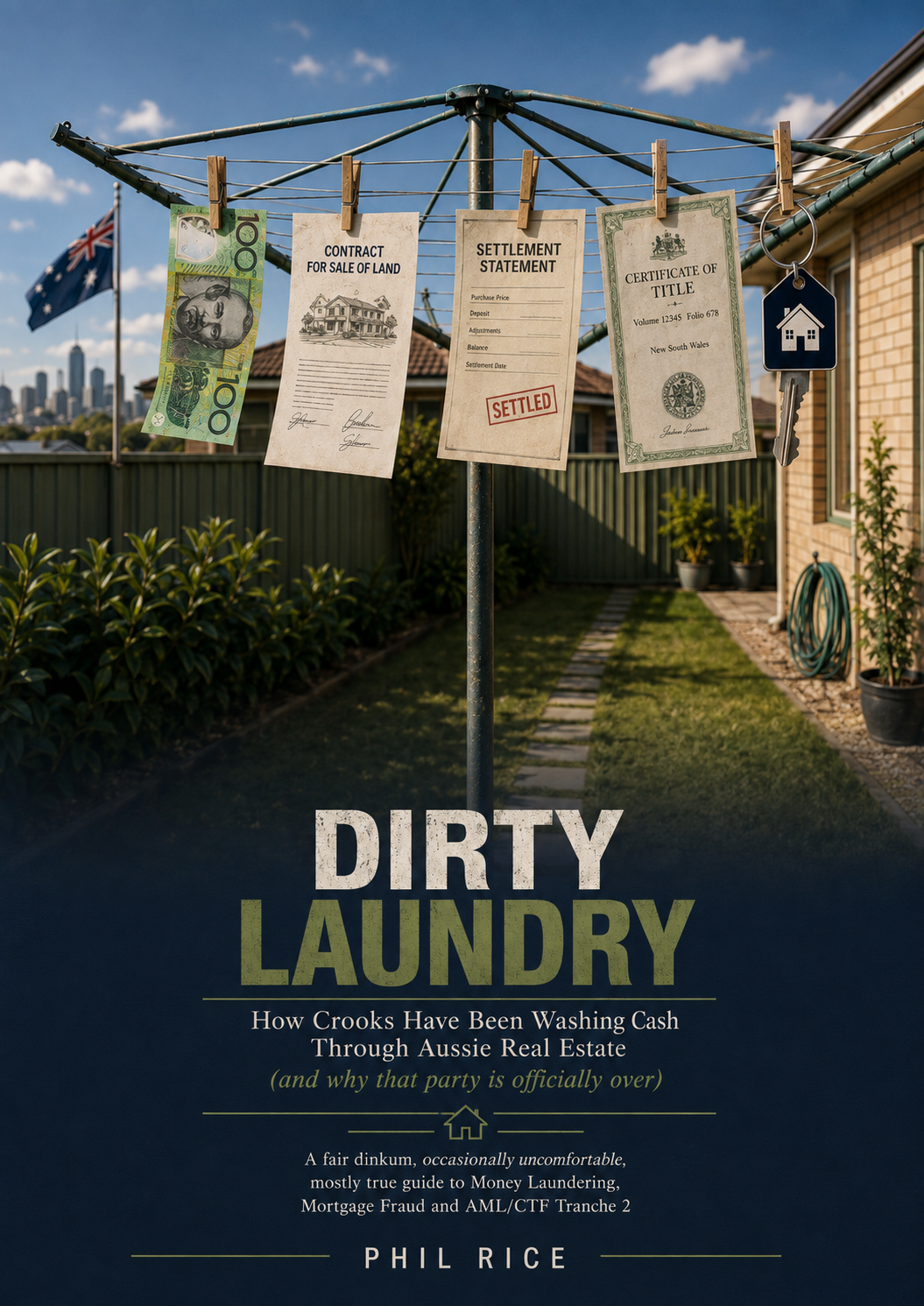
A Quick Word Before We Get Into It
G'day. If you've picked this up expecting a dry government pamphlet about Anti-Money Laundering and Counter-Terrorism Financing law, you're half right — it is about that. But I promise you, by the end of this, you'll actually understand it, and you might even laugh once or twice. Which, for a subject invented by lawyers and enforced by an agency called AUSTRAC, is no small achievement.
Fair warning: I've got a satirical streak, and this guide doesn't hide it. There's a lot in this industry that deserves to be laughed at — the software vendors who rebadged a template overnight and called it a "compliance solution", the principals who genuinely believed "I've been doing this thirty years, I can smell a dodgy buyer" was a legally defensible position, and an entire profession that spent two decades assuming money laundering was something that happened to other people, in other countries, in movies with subtitles. None of that is laughed at to make light of the crime itself — laundering is a serious business with serious victims. It's laughed at because the industry's response to it has, at times, been genuinely ridiculous, and ridiculous things are allowed to be mocked.
I've been in finance for thirty years. I was a bank manager for seven of them, and I was sitting inside the finance industry in 2008 when AML compliance became a very real, very unavoidable part of everyday banking life. I've since built the finance arm for a national real estate franchise, become a Certified Professional Business Advisor, and founded AML HQ — a business built specifically to help real estate principals survive the same transition the finance industry went through nearly two decades ago.
Real estate agents are now facing exactly what banks faced back then. From 1 July 2026, under what the industry calls "Tranche 2", real estate agents became a regulated "designated service" under the AML/CTF Act — the same Act that has fined the big banks well over a billion dollars between them. No agency is too small to be caught. No principal is too busy to be responsible.
The Beige Brick Special
Picture a fairly ordinary Saturday open house. Beige brick veneer, three bedrooms, a Hills Hoist that's seen better decades, and a young couple wandering through pretending to care about the size of the linen cupboard. Twenty minutes later, a cousin of a cousin's business associate makes an offer $40,000 above asking price — cash settlement, no finance clause, keen to move fast. The agent punches the air. Vendor's rapt. Everybody wins.
Everybody wins! Champagne on ice, another glowing testimonial for the agency Facebook page, and a heart-warming little parable about the power of a hot market. Nobody in the room asks the one question that might have ruined the mood: why would anyone, in their right mind, pay $40,000 over the odds for a house with a Hills Hoist that's seen better decades?
This isn't a real transaction — it's a composite, built from the patterns AUSTRAC itself has published after years of examining actual money laundering cases through Australian property. But every element of it is real, and it happens more often than most agents would ever guess.
The Cleanskin
AUSTRAC calls it using a "third party". Everyone else calls it a cleanskin — someone with no criminal record and no reason to raise suspicion, who buys the property on behalf of someone who very much does have a reason to raise suspicion. It might be a cousin, a partner, an employee, a mate from footy training. The cash isn't theirs. The instructions aren't theirs. But the name on the contract is, and that's the entire point. It's essentially fronting a band, except instead of miming guitar you're miming home ownership, and instead of a pub gig the reward is a house nobody can ever trace back to the person who actually paid for it.
The Money That Never Says Its Name
Then there's structuring — depositing cash in amounts just under $10,000 across different banks, different branches, different days, specifically so no single deposit trips a Threshold Transaction Report to AUSTRAC. There's the loan-back scheme, where an offshore "lender" conveniently provides finance that never quite gets repaid in any traceable way. There's the classic over-the-odds purchase, where the extra tens of thousands above market value quietly move from dirty to clean the moment the contract settles. And there's the renovation — a discreet favourite, because cash paid to a builder who doesn't ask questions is one of the oldest laundering tricks in the country. Somewhere in Australia right now, a kitchen splashback is doing more heavy lifting for organised crime than any offshore shell company ever managed.
None of this requires a criminal mastermind. AUSTRAC's own guidance is blunt about why real estate is such an attractive target: it's simple, it doesn't require special expertise, it can absorb enormous sums in one transaction, and — until 1 July 2026 — nobody standing in the room during the sale had any legal obligation to notice, ask, or report.
Why Now? The Tranche 2 Story
The Anti-Money Laundering and Counter-Terrorism Financing Act 2006 (Cth) has been law for two decades. It created two tiers of regulated businesses. "Tranche 1" covered the financial sector — banks, remittance dealers, casinos, bullion. "Tranche 2" was meant to cover the other classic laundering gatekeepers: lawyers, accountants, trust and company service providers, and real estate agents. For reasons that had a lot to do with lobbying and not much to do with logic, Tranche 2 sat on the shelf for the better part of twenty years.
Meanwhile, AUSTRAC, the Australian Federal Police and the Australian Criminal Intelligence Commission told a Federal Senate inquiry, in plain terms, that criminals were routinely using lawyers, accountants and real estate agents to launder billions of dollars a year through the property market — precisely because none of those professions had to ask a single question about where the money came from.
The Anti-Money Laundering and Counter-Terrorism Financing Amendment Act finally passed in 2024. Real estate agents, buyer's agents and conveyancers all became "designated services" under the Act, with obligations commencing 1 July 2026. There is no small-agency exemption. A sole trader with one appraisal a fortnight carries the same legal obligations, in principle, as a 40-office franchise group.
What Actually Changed on 1 July 2026
- Real estate agencies facilitating the sale, purchase or transfer of property became AML/CTF "reporting entities".
- A written, tailored AML/CTF program became mandatory — not a template, a document specific to your agency's actual risks.
- Every reporting entity now needs a designated, fit-and-proper Compliance Officer, named with AUSTRAC.
- Customer due diligence — identity verification — must occur before the designated service begins, with enhanced checks for higher-risk clients.
- Ongoing monitoring, suspicious matter reporting, threshold transaction reporting and seven-year record keeping all became legal requirements.
If that list feels like a lot for an industry that, until recently, mostly worried about whether the postbox had the right key in it — that's because it is a lot. It's exactly what the finance industry was handed in 2006, and lived through in earnest from 2008 onward. I was there for that transition. It was clunky, it was resented, and within a few years it was simply how the industry worked. Real estate is about to go through the same thing, just compressed into a shorter runway.
⚠ Important Note: AUSTRAC does not endorse, certify or approve any private AML/CTF compliance provider — not AML HQ, not anyone. Anyone who tells you otherwise is already failing the honesty test this whole guide is about.
How They Actually Do It
AUSTRAC has published its own strategic analysis of money laundering through Australian real estate, built from years of real cases. It reads like a highlight reel of tricks that are, once you know them, almost insultingly simple:
- Third parties / "clean skins" — a friend, relative or associate with no record buys the property on the real owner's behalf.
- Unusual loans and "loan-back" schemes — offshore lenders provide finance that conveniently launders funds through loan repayments.
- Valuation manipulation — buying or selling well above or below market value, with the difference made up in undisclosed cash.
- Structuring — cash deposits kept just under the $10,000 reporting threshold, spread across banks and branches.
- Rental legitimisation — a "tenant" who is really a collaborator, paying rent with funds supplied by the property's true controller.
- Renovation laundering — illicit cash funnelled into home improvements, which then quietly reappear as a higher, legitimate-looking resale value.
- Shell companies, trusts and layered structures — used to put as much distance as possible between the criminal and the title deed.
None of this needs a criminal genius. It needs an unquestioning intermediary, a bit of patience, and — until now — an entire profession with zero legal requirement to ask a single question. That last part is precisely what changed.
The Big Bank Lesson
It's worth remembering that Australia's biggest banks, with compliance departments running into the hundreds of staff, legal teams on speed dial and risk committees that meet more often than most families do at Christmas, have been caught out on exactly this legislation — at a scale that should terrify any two-agent office relying on a $19-a-month software subscription and a good feeling about people.
If institutions with legal teams, risk committees and dedicated compliance officers on six-figure salaries can still get caught flat-footed, it should tell every real estate principal something important: this is not a box you tick once with a software login and forget about. It is an ongoing discipline, and AUSTRAC has shown, repeatedly, that it is willing to hand out penalties that would end most real estate businesses in a single afternoon. If Westpac — a bank literally built on the business of managing money — can rack up 23 million breaches, the idea that a real estate office will get this right by vibes alone is, respectfully, a fantasy.
When 200 Innocent People Lost Their Jobs Overnight
Money laundering and mortgage fraud aren't the same thing — but they sit right next door to each other, and the mortgage broking industry's most dramatic recent case shows exactly what happens when an industry panics about one and ends up punishing an entire network for it.
In April 2026, aggregator Finsure terminated its sub-aggregation agreement with Hai Money, a Sydney-based broker network, after several individual brokers were suspected of fraudulent conduct. Hai Money had around 211 brokers under its umbrella. Almost overnight, every one of them lost access to the Australian Credit Licence they needed to write a loan, chase a settlement, or receive a commission — whether they had ever been accused of anything or not.
"When more than 200 brokers can suddenly lose the ability to write loans, support clients, settle deals, receive income and maintain lender access, we are no longer just talking about fraud control. We are talking about career destruction by association." — Phil Rice, The Adviser, May 2026
The legal fight that followed is genuinely instructive — Justice Kate Williams granted Hai Money an interim injunction, noting that at that point, there was no evidence before the court that Hai Money or any of its brokers had actually committed the fraud Finsure relied on to terminate. Finsure terminated first and asked questions never.
The Lesson for Real Estate
Whatever the final outcome, the pattern is the lesson: an entire network of licensed, working professionals can be shut down commercially in days, based on association rather than individual findings, once an industry decides it needs to be seen acting. Real estate is walking into the same regulatory environment mortgage broking has lived in for years — AUSTRAC obligations, lender-style scrutiny, and an industry watching nervously for the first big public failure.
The agencies that will weather that moment are the ones who can show, file by file, exactly what they did and why — a named Compliance Officer, documented decisions, a genuine audit trail. The agencies that can't show that are the ones who become the next cautionary tale, guilty or not.
What AUSTRAC Actually Expects
Strip away the acronyms and AUSTRAC's expectations of a real estate reporting entity come down to eight fairly plain requirements. None of them are exotic. All of them need to be genuinely in place, not merely claimed:
- A written AML/CTF program, tailored to your specific agency — not a generic template.
- A designated, fit-and-proper Compliance Officer, named and accountable.
- Customer due diligence completed before your designated service begins, risk-based and proportionate.
- Ongoing monitoring of client relationships — risk isn't fixed at the start of a transaction, it can change.
- Threshold Transaction Reports lodged within ten business days for cash transactions of $10,000 or more.
- Suspicious Matter Reports lodged the moment a genuine suspicion forms.
- Records kept for a minimum of seven years, secure and producible on request.
- Staff training that's documented, current, and genuinely understood — not just ticked off.
- Independent review of the whole program at least every three years.
⚠ The Penalties Are Real: From 1 July 2026, the maximum civil penalty for a body corporate is 100,000 penalty units — currently $36.4 million. For an individual non-corporate reporting entity, it's 20,000 penalty units — $7.28 million. Those numbers apply per contravention, not per business. A busy agency that gets this wrong across multiple files isn't looking at one fine — it's looking at a multiple of one.
The Bottom Line
Every real estate principal reading this now knows more than most of the industry did a year ago. You know why Tranche 2 exists, and it isn't red tape for its own sake — it's a response to billions of dollars a year moving through exactly the transactions your agency handles every week. You know how the laundering actually works, because it isn't complicated once someone shows you the pattern. You've seen what happens when an industry panics and punishes everyone instead of the guilty — and you've seen what it looks like when a genuine, evidenced compliance program is standing behind you instead.
The law changed on 1 July 2026. AUSTRAC isn't going anywhere, and neither is the next test case. The only real question left is whether your agency can prove, file by file, that it did this properly — or whether you find out the hard way, in front of a regulator, an auditor, or a court.
Nobody else is going to do this for you. Software won't. A generic template won't. A cheerful sales rep who's never met AUSTRAC won't.
It's now up to you, to do your part.
Don't Navigate Tranche 2 Alone
AML HQ works with real estate agencies to build compliance programs that are defensible, documented, and audit-ready. Our CO Model puts a named Compliance Officer behind your agency — not just a login screen.
Book a Compliance AssessmentAbout the Author: Phil Rice is the Founder and Chairman of Emerald Group Holdings, and the founder of AML HQ. He has spent thirty years in finance, including seven years as a senior bank lending manager, and was working inside the finance industry during its own AML transition from 2008. He is a Certified Professional Business Advisor (CPBA) through the Institute of Advisors, and an Australian Credit Licence holder. This guide is provided for general information and educational purposes only. It does not constitute legal, financial, regulatory, or compliance advice. Reporting entities should seek independent professional advice. Australian Credit Licence 392611.